Grapevine downy mildew is one of the biggest nightmares for winegrowers. Certainly, in the northernmost regions of our country, they are used to having to manage this disease—or, better yet, prevent it.
“We conduct annual inspections using maps to make sure we’re treating the area properly, and there’s no doubt about that. Martignani sprayers are reliable.”
With the ongoing climate changes we have been experiencing in recent years, concerns about downy mildew have spread to other regions of Italy as well.
Weather conditions during the first weeks of spring play a decisive role in the development of grapevine downy mildew. High humidity and mild temperatures can create an ideal environment for the disease to emerge; if underestimated, it can compromise the productivity of the entire vineyard.
To discuss this topic, we traveled to Siena to visit the Losi Paolo e Pietro Winery.
Losi Farm
Just a few kilometers from Siena, in the municipality of Castelnuovo Berardenga, in the southernmost hills of Chianti, the Losi Winery occupies a privileged location—both for its excellent exposure and the richness of its soil—on the slopes of the Certosa di Pontignano.
The Losi family, a long-standing family of Chianti winemakers, has been producing wine for five generations: their deep passion dates back to 1870, and they have become champions of Chianti Classico and its native grape varieties. Specifically, the winery is dedicated to producing Chianti Classico Gallo Nero (the emblem of the Chianti League since the 14th century).
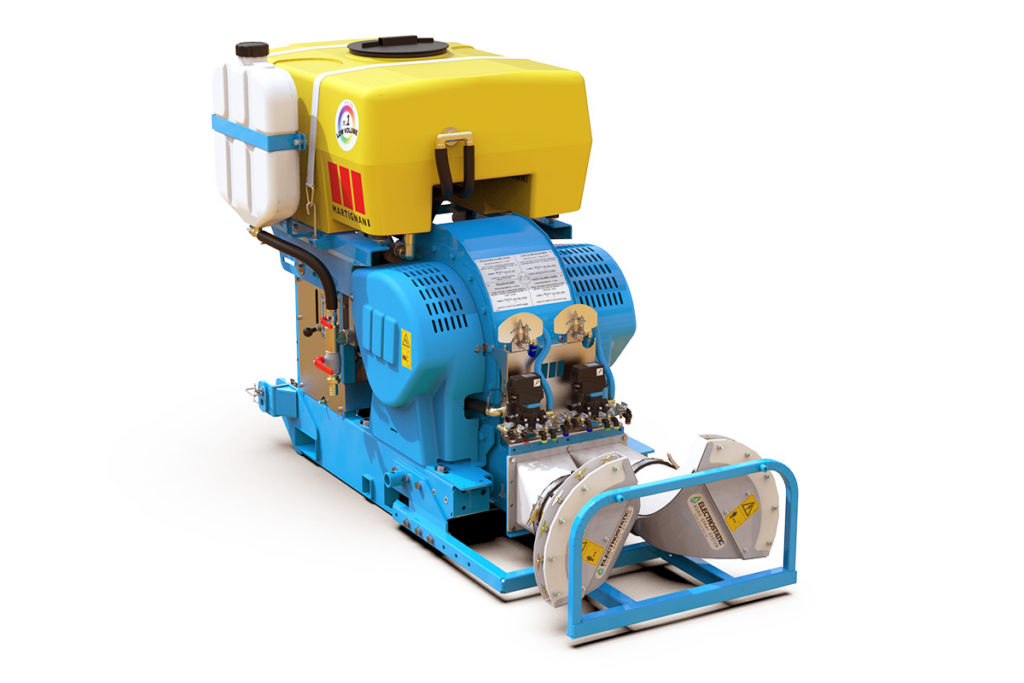
The Losi family has been a Martignani customer for more than 20 years. They own 30 hectares of Chianti vineyards, which they treat with a Martignani Whirlwind 1,000-liter sprayer . And they recently purchased a new Phantom M120 1,000-liter pull-type sprayer, the “California Vigneto” model.
MARTIGNANI TREATMENTS AGAINST DOWNY MILDEW
We spoke with both one of the company’s founders, Mr. Paolo Losi, and his grandson Riccardo Losi to learn about their experience in preventing and controlling grapevine downy mildew.
The Losi winery performs 7 to 12 treatments per year, “it always depends on the season.” They use both conventional and organic methods, and as for the volume of water used, “we start at 100 liters per hectare and, as the season progresses, we increase it to 200 or 250 liters per hectare.”
Our customers add that the first treatments are applied “to alternate rows, and then we treat all the rows,” and as for downy mildew, they acknowledge that the challenges have increased in recent years. Rapid changes in weather conditions and sudden, sometimes heavy rains increase the risk of the disease breaking out and the first symptoms (or spots) appearing on the leaves. To address this situation, “we try to monitor the situation constantly and apply treatments proactively. We must always be ready.”
From this perspective, Riccardo Losi laments that “it’s shaping up to be a difficult year. It’s raining every day and temperatures are high; it feels like a carbon copy of 2023, which was a very complicated year—one of the worst.” He then adds that,“Martignani technology is a huge help because, on the one hand, the outlet allows for precise targeting, while the electrostatic charge reduces drift since the droplets are attracted to the vegetation. The product is distributed perfectly, and this is essential for preventing the disease.”
Riccardo Losi says, “We conduct annual checks using maps to see if we’re treating the crops properly, and there’s no doubt about it. Martignani sprayers are reliable.”
SAVINGS AND SUSTAINABILITY
Thanks to their electrostatic charge and low volume, treatments using Martignani sprayers result in significant savings in water, product, diesel fuel , and labor . On this subject, Riccardo Losi says that “as far as water use is concerned, the savings are very substantial.”. Instead, we use the product specified on the label. Thanks to Martignani’s effectiveness, what we do is stop the treatments earlier. For example, if the vineyards are in good condition and free of pests and there are no risks—as has often been the case since we started using Martignani—we’ve finished treating by mid-July (weather permitting). We don’t do the final pruning. And that’s how we save on product, time, and diesel.” He then adds that, “on a farm like ours, two fewer treatments per season means a savings of about €5,000.”
Furthermore, Mr. Losi points out that “nobody talks about it, but Martignani treatments drastically reduce pollution—not only because the product doesn’t end up on the ground and there’s no drift loss, but also because using the tractor less means you can replace the tires less often. Otherwise, you have to replace the tires every 3 or 4 seasons, and that’s very polluting.”
In conclusion, both Paolo Losi and Riccardo Losi agree on the reliability of Martignani sprayers in preventing grapevine downy mildew and improving the quality of the vineyard.
We would like to thank the LOSI FAMILY for their cooperation and for the trust they have placed in MARTIGNANI SRL.
Gallery
Learn about the sprayer
Discover the advantages of our atomizer
You might also be interested in.
Are you looking for a sprayer?
Discover the entire Martignani line