
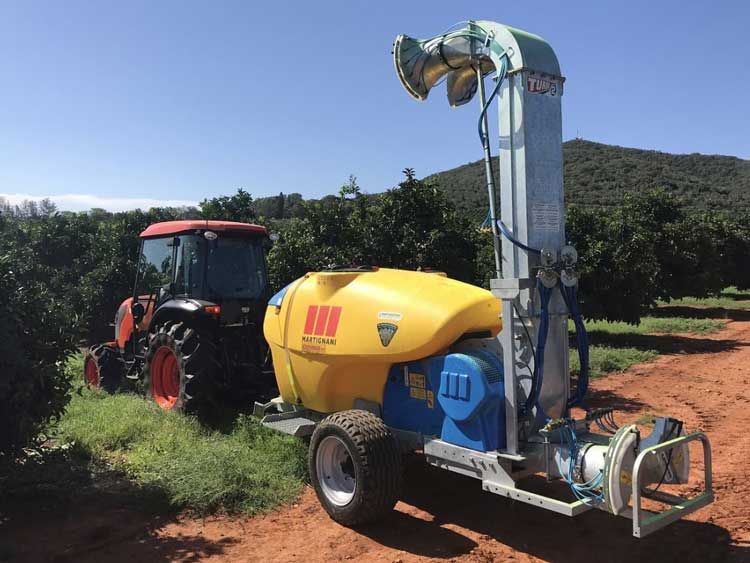
The “Südtirol 2015” sprayer (model M-612 Multi-Flow) from Martignani S.r.l. of S. Agata sul Santerno (RA) is a sprayer featuring an innovative system for directing and regulating airflow that creates an “air curtain” to protect sensitive areas near the edge of the treated plot (Fig. 1). This “curtain” prevents the pesticide mixture—which may not have been deposited on the target—from reaching areas other than the one being treated, thereby reducing the risk of drift during the application of pesticides (primary drift).
The model under test was designed as an evolution of the previous “Südtirol 2001” machine (Fig. 2), which was developed to tend orchards in the South Tyrol region. These orchards have historically been characterized by notably tall canopies, but over the years they have undergone significant changes in planting patterns and structure due to the adoption of more modern pruning techniques.

Figure 1 – “Südtirol 2015” Model M-612 Multi-Flow sprayer being tested at the Spagolle Experimental Farm, managed by the E. Mach Foundation

Figure 2 – Südtirol 2001 Pneumatic Sprayer
Materials and Methods
The treatment was conducted in a Fuji apple orchard with a row spacing of 3.4 m, adjacent to another orchard planted with Golden Delicious apples with the same planting pattern. The plot, planted in 2009, is located on a gentle slope (3%) and has rows oriented north-south. At the time of the experiment, the trees were approximately 3.2 ± 0.2 m tall.
The equipment under test was calibrated by technical staff from Martignani to apply 300 L/ha of a concentrated mixture containing various plant protection products, whose active ingredients had not been used in the farm’s plant protection program prior to the trial (Table 1).
Table 1 – Tracer plant protection products used during the experiment
| Commercial Product | Active ingredient(s) |
| Bellis | Boscalid and pyraclostrobin |
| Geoxe | Fludioxonil |
| Dursban 75 WG | Chlorpyrifos |
To verify the above, a sample of apples was collected before the test began, and the four active ingredients used in the tracer mixture were analyzed in the sample. The results of the analysis are shown in the table below (Table 2).

Table 2 – Results of the multi-residue analysis of a pre-treatment sample to rule out the possibility that the tracer mixture had ever been used on the test plot.
The application was carried out under windless conditions (average wind speed 0.2–0.3 m s⁻¹), early in the morning, and fruit sampling in the rows adjacent to the treated area was conducted in the late afternoon of the same day (August 11, 2016).
The treatments and subsequent sampling were carried out according to the experimental design shown in Figure 3.

Figure 3 – Treatment and Sampling Scheme for the Experiment
For each of the three treatments, four samples of 25 apples each were collected—both from the row immediately adjacent to the treated rows and from the next row—and delivered to the Mach Foundation’s chemical laboratory to determine the residues of the active ingredients used in the test.
In order to highlight the differences between the treatment methods under comparison in terms of the drift generated, the data obtained were subjected to an analysis of variance. The statistical test used was the one-way Kruskal-Wallis ANOVA, a nonparametric method for comparing multiple groups with independent samples. The analysis was conducted separately for each of the two untreated rows included in the sample, and—to better highlight the differences between the treatments, without taking into account the type of active ingredient (given the low level of contamination, which was very close to the limit of detection)— —thus increasing the number of replicates for each treatment regimen.
Results and Discussion
Table 3 shows the results of the analyses of samples collected from the first row adjacent to the treated plot. The data are broken down by each analyte tested, and it is evident that the contamination levels found in the apples are just above the instrumental detection limit for each active ingredient considered, even for the samples from this row.

Table 3 – Results of the analyses conducted on samples of Fuji apples harvested from the first row adjacent to the treated rows
Similarly, Table 4 shows the results of the analyses of samples collected from the second row adjacent to the treated plot, following the untreated Fuji row.
Table 4 – Results of the analyses conducted on samples of Golden apples harvested from the second row adjacent to the treated plots
Even from a first glance at the results, it is clear that under the test operating conditions, compared to the reference configuration—the machine operating without the use of an electrostatic charge and with nozzles perpendicular to the rows —the solution with the electrostatic charge transfer device activated did not result in any improvement in drift contamination in the rows adjacent to the treated plot. In fact, the number of contaminated samples and the amount of active ingredients detected were very similar for both the row adjacent to the last treated row and the row following it. Adjusting the sprayer so that the nozzles were parallel to the treated row—and the resulting formation of an air curtain to protect the rows adjacent to the treated ones —in combination with the active device for electrostatic charge—while resulting in a level of contamination on the row adjacent to the treated one comparable to that of the other treatments, completely prevented contamination of the Golden Reinders row.
No further evidence emerged from the statistical analysis of the data. In fact, for apples from both the row adjacent to the treated rows and the row following them, the contamination levels for the various tracer active ingredients were found to be statistically indistinguishable (p<(0.05) for each of the tested configurations. It was possible to observe greater differentiation among the treatments—albeit only a trend—by disregarding the type of tracer active ingredient and thereby artificially increasing the number of observations for each test configuration (Kruskal-Wallis test: H [2, N = 48] = 5.374175, p = .0681) for the Fuji samples adjacent to the treated ones, but not for the Golden samples (Kruskal-Wallis test: H [2, N = 48] = 2.977841, p = .2256).
The trial was conducted at the Spagolle Experimental Farm of the De Bellat Foundation, located between Castelnuovo and Borgo Valsugana (TN), which is partly managed by the E. Mach Foundation in S. Michele all’Adige.
Edmund Mach Foundation/Agricultural Institute of S. Michele all’Adige
CTT—Plant Protection and Agroforestry Biodiversity Unit
Via Machl
S. Michele all’Adige (TN) – ITALY
Email: centrodisaggio.ctt@fmach.it
| YEAR | 2016 |
| CULTURE | Appie, Malus domestica, MABSD |
| TARGET | Reduction of drift |
| SPONSOR | Claudio Martignani |
| Martignani, LLC |
STUDY DIRECTOR: Dr. GINO ANGELI (gino.angeli@fmach.it)
PRINCIPAL INVESTIGATOR: Dr. Daniel Bondesan (Daniel.bondesan@fmach.it)
TESTING CENTER MANAGEMENT: FEM/IASMA Testing Center (Ministerial Decree of June 6, 2000, Ref. No. 33038; Ministerial Decree of March 10, 2005, Ref. No. 39023; Ministerial Decree of February 23, 2010, No. 03757; and Ministerial Decree of June 24, 2011).
VALIDATION OF THE STUDY
The study was conducted in accordance with Good Experimental Practices (GEP) and in compliance with Regulation (EC) No. 1107/2009 of the European Parliament and of the Council of October 21, 2009.
Date: January 24, 2017
You might also be interested in.
Are you looking for a sprayer?
Discover the entire Martignani line