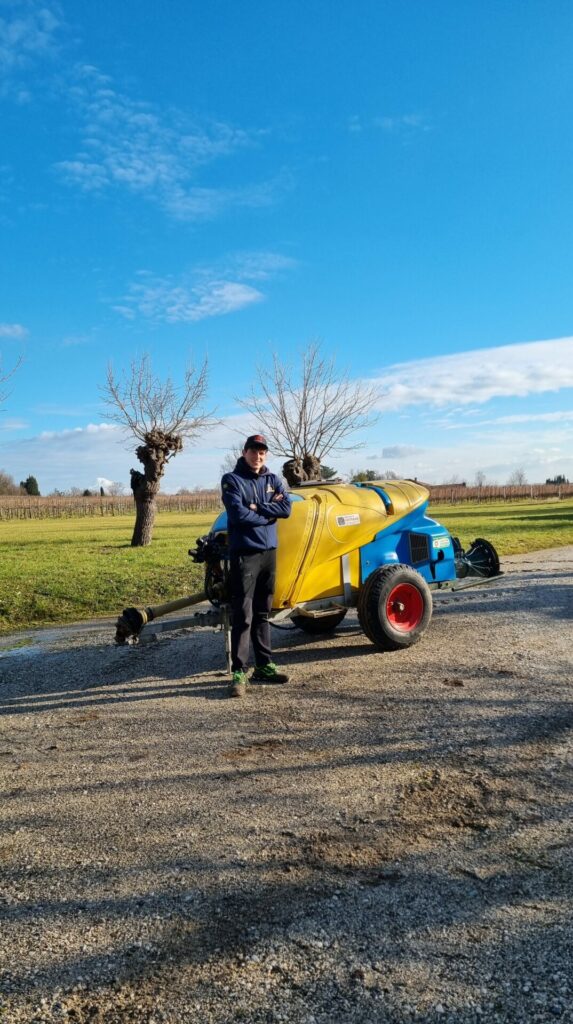
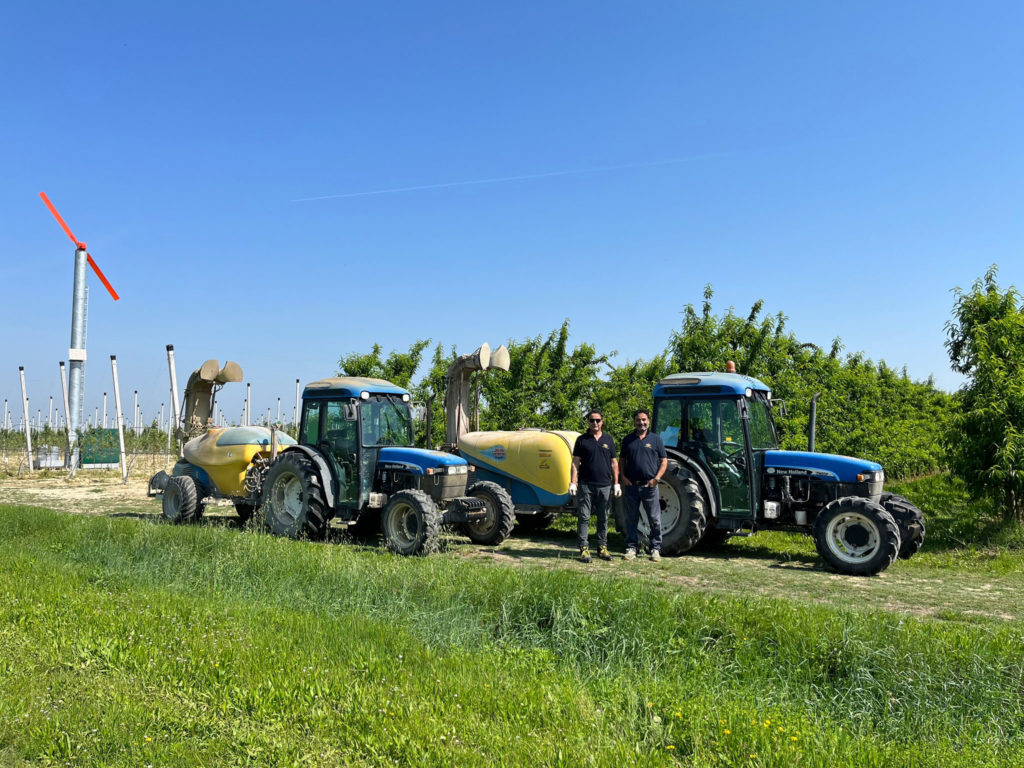
We were in Friuli to speak with one of our long-time customers. He’s had our sprayers for nearly 30 years, and with very little maintenance, he continues to use them to this day without any problems.
We spoke with Davide Dolso, the vineyard manager at Azienda Poggio in the town of Fagagna. He’s a young man who’s passionate about agriculture done right and in an eco-sustainable way.
“We apply the treatment in alternating rows, at a travel speed of about 7 km/h, applying 65 liters per hectare.”
What is the name of the farm, and where is it located?
It’s called Azienda del Poggio and is located in Italy, in Friuli-Venezia Giulia, in the province of Udine, in the municipality of Fagagna—more specifically in Villalta di Fagana, along the road connecting Martignacco to Moruzzo.
What is your role within the company?
My role within the company is primarily the management of the vineyards and the winery, where our grapes are transformed into wine—and more.
How many hectares are under cultivation, and what crops are grown there?
We currently have 18 hectares of vineyards and 1 hectare of olive groves, where we perform all treatments using the Martignani sprayer.
Can you tell me which Martignani sprayer model you use and how long you’ve been using it?
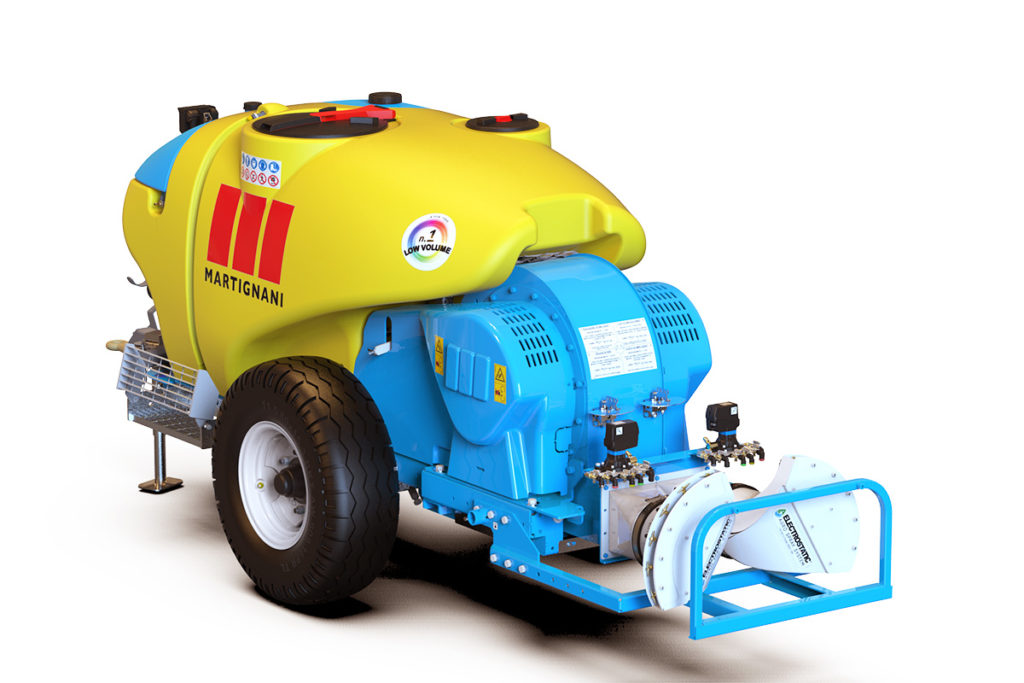
The model we use at our company is the B 612.
We purchased the sprayers in 1998, and they have always remained highly efficient, thanks to the routine maintenance that is performed on them.
What kind of treatments do you perform? Number of treatments, speed, volume, etc.
I mainly perform plant-protection treatments.
For the past few years, due to high temperatures, we’ve started applying kaolin treatments to reduce heat stress on the plants.
We perform an average of 10 treatments per year, though this number may vary depending on how rainy the season is.
For the first treatments, we treat every other row at a speed of about 7 km/h, applying 65 liters per hectare.
Once the canopy has developed, we treat all rows, reducing the speed to 6.5 km/h and applying a maximum of 230 liters per hectare.
The amount of water per hectare could be reduced even further by replacing the sprayer with a more modern one that uses electrostatic technology.
Do you also grow organic produce?
We don’t grow organic produce because the area where we’re located doesn’t allow us to do so due to ongoing climate change, which is making things increasingly difficult for us during the growing season.
What do you think are the main advantages of Martignani technology?
In my opinion, the main advantages of a Martignani sprayer are definitely the way it distributes the product over the plant, covering the entire leaf surface; the reduced water usage; the resulting reduction in time spent refilling the tank; and the reduced amount of plant protection products used.
Finally, there is a significant reduction in drift, which is very low.
Some of our customers around the world have told us that, when you factor in water, product, diesel, and time, treatments with Martignani save about 250€ per hectare per year. Once you’ve paid for the machine, of course. Do you see those savings as well?
I fully agree with your customers, especially in this period when there’s a shortage of tractor operators; every minute saved on treatments allows us to perform other tasks in the vineyard.
Is there anything else you’d like to add?
One thing I’ve learned over time is that everyone thinks you need to use a lot of water to thoroughly wet the foliage, otherwise we risk getting diseases; however, by using these sprayers, I’ve realized that we can be much more environmentally sustainable.
Similarly, the products we apply to the plant are distributed evenly, thanks to the spray system—combined with electrostatic mist-blowing in the more modern models.