Today we’re having a pleasant conversation with Charl Wynand Rautenbach (father) and Stephan Ignatius Rautenbach (son), joined by Conray Van Rooyen, Benjamin Board Ferreira, Elrico Mulder, and Alessia Toia from SouthTrade International.
We are near the town of Patensie, a small town of about 5,000 residents located in southeastern South Africa, in the Eastern Cape province.
The town, and the entire valley in which it is located, is an important center for citrus, tobacco, and vegetable cultivation.
Roikrans Agri Business Ltd
The Rautenbachs own the farm “Roikrans Agri Business (pty) Ltd,” and their holdings include 53 hectares of table grapes and 150 hectares of citrus fruits.
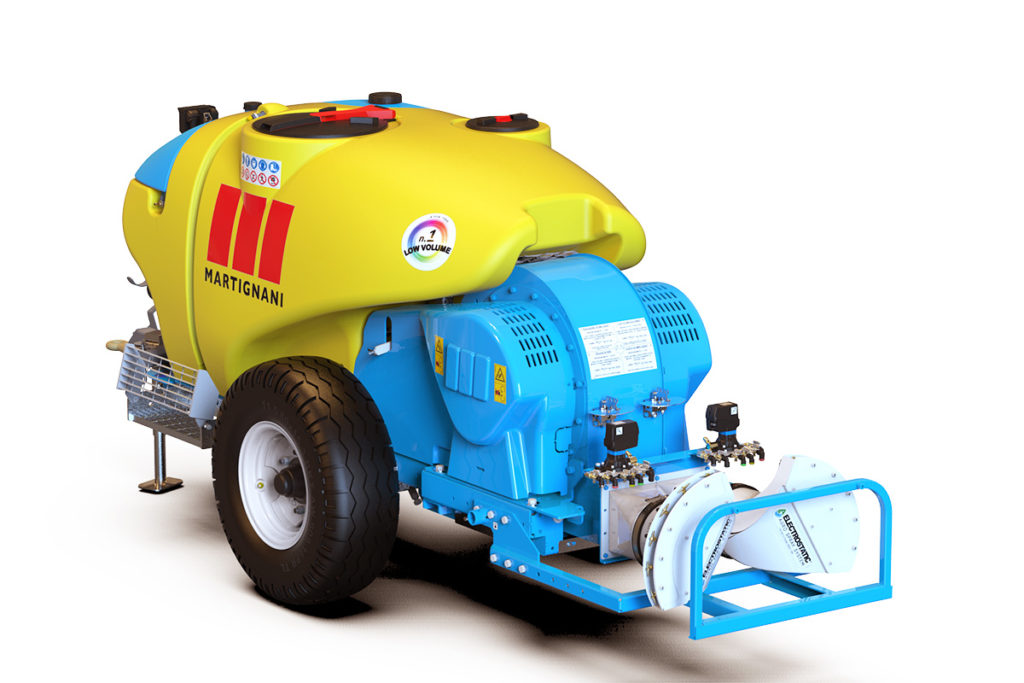
Our interesting and pleasant conversation took us back in time, specifically to when Southtrade introduced them to Martignani’s technology and electrostatic pneumatic sprayers, followed by a nighttime demonstration. The results—in terms of product coverage—were so evident and excellent that they were definitively convinced to equip their farm with these sprayers.
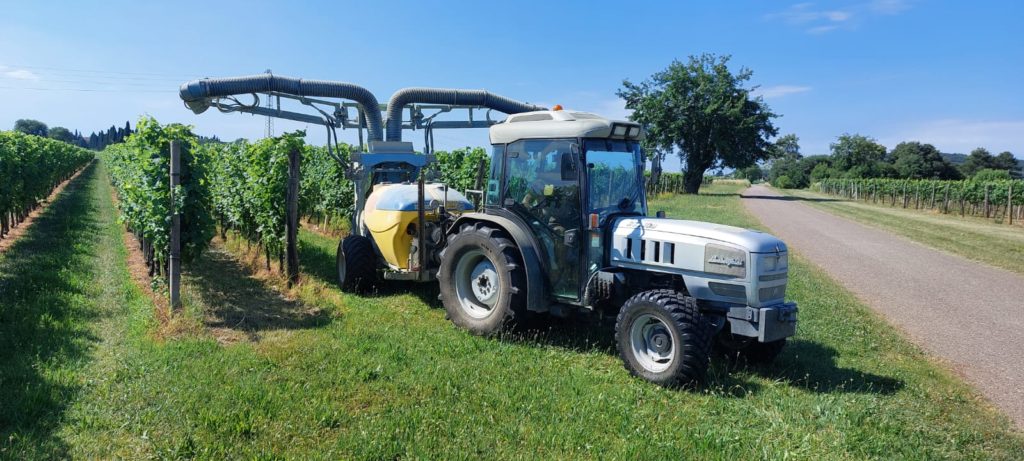
They purchased their first sprayer in 2015; today they own two M612 Turbo 2 1,500-liter machines that are used exclusively on 70 hectares, since the trees on their other plots are still small.
Advantages of Martignani Machines
The main benefits they’ve gained from using Martignani’s Electrostatic Spray System speak for themselves, and we’ve summarized them in this table:
– 50% less time
– 50% less work
– 20% to 35% less use of crop protection products
– 90% less water
Specifically, these farmers apply treatments to young plants using only 300 l/ha at a speed of 3.2 km/h and treatments to mature plants (approximately 3.5 meters tall) using 500 l/ha at a speed of 1.3 km/h, whereas previously, with conventional sprayers, the volumes of water used were always greater than 5,000 l/ha.
Among the other advantages the Rautenbachs have observed, it’s also worth noting that Martignani machines operate continuously, stopping only a few times (compared to machines from competing companies) for maintenance—and, when it comes to problems related to clogged nozzles, a constant thorn in the side of conventional sprayers—they have never had any problems.
Mr. and Mrs. Rautenbach were keen to emphasize that they were Martignani’s first customers in that area, and now there are 21 Martignani machines operating in that area (primarily 1,500-liter M612 Turbo 2 models), distributed among 8 farms, one of which alone owns 7.
Since Patensie is located in a valley dedicated to citrus cultivation, the 21 Martignani machines currently in that area are used primarily for that crop—specifically, oranges, mandarins, and lemons.
They found that the fruit is of higher quality due to the absence of chemical residues and blemishes, and, as a result of reduced use of pesticides, they also observed a marked improvement in air and soil quality, due to less pollution from spray drift.
At this point, the pleasant conversation came to an end. We thanked all the participants for the warmth and professionalism with which they engaged with us, and once again we can say with satisfaction that Martignani’s corporate mission has been accomplished. We are confident that, in addition to everyone involved in the conversation, the environment and the health of both workers and consumers will reap great benefits.